
Colours
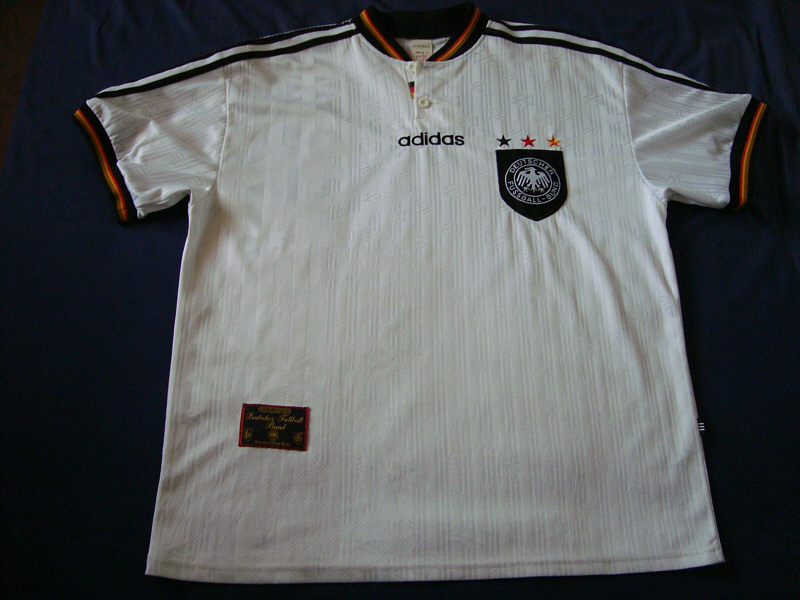
Home: White shirt with black trim and crest in black shield, black shorts with white trim, white socks.
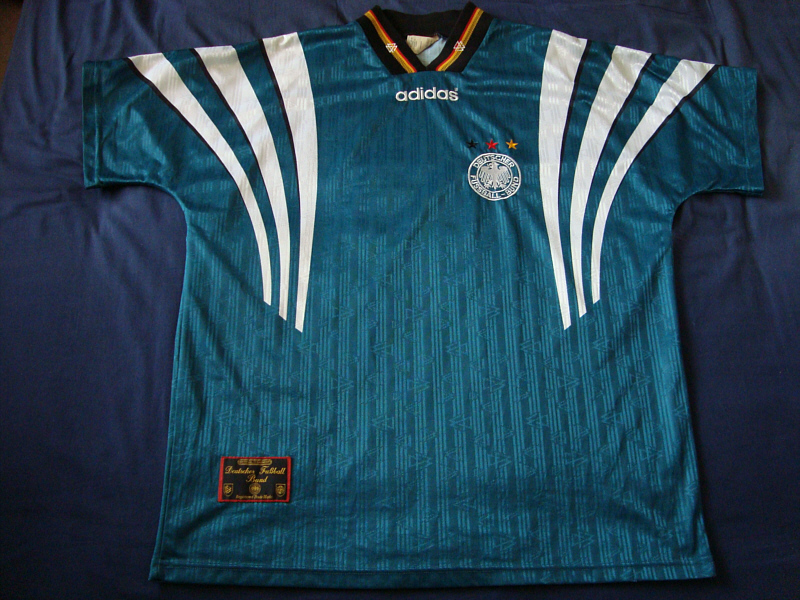
Away: Green shirt with three white stripes on each side, white shorts with green trim, green socks.
Overview
Coach: Berti Vogts
Something of an antidote to the 1994 design, the two shirts that debuted in 1996 took on a more traditional look, but with a modern twist. Gone was the massive display of Schwarz-Rot-Gold – which was now back as subtle piping on the neck and collar; this shirt was more in line with the Germany shirts of old, something that even coach Berti Vogts would have looked at home in.
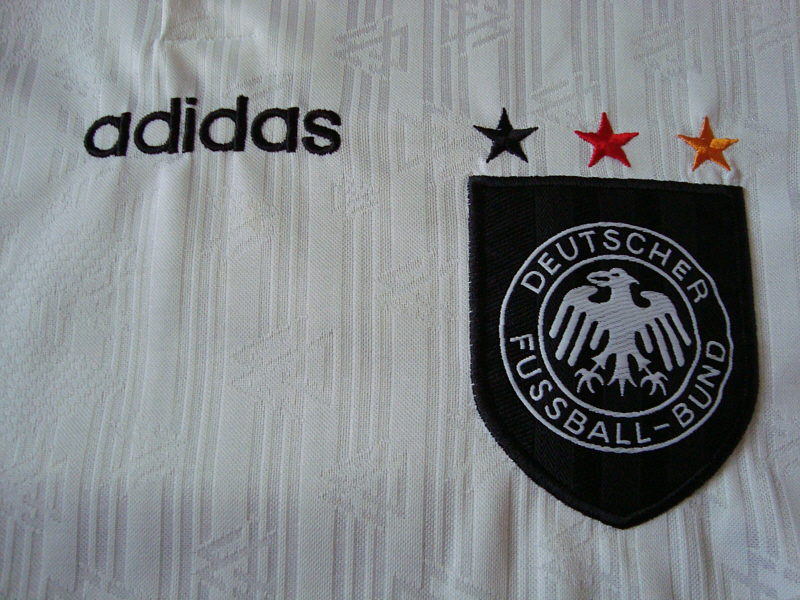
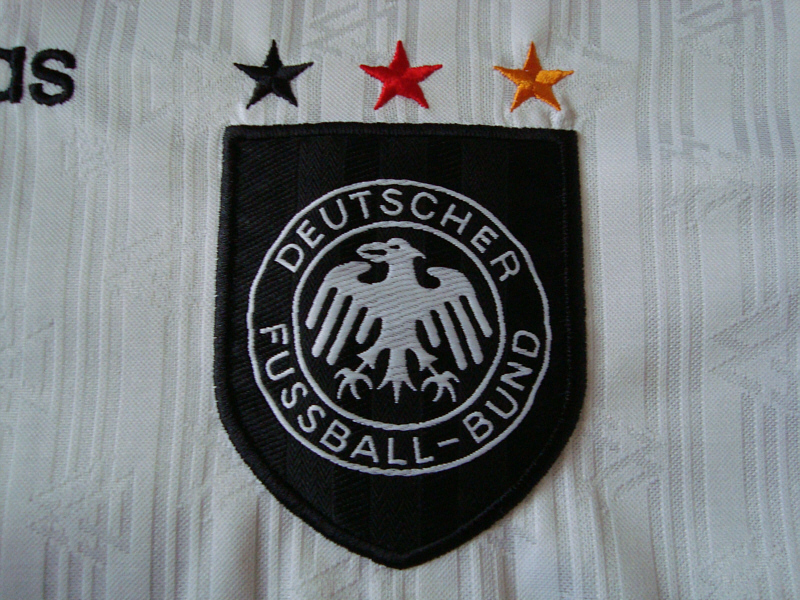
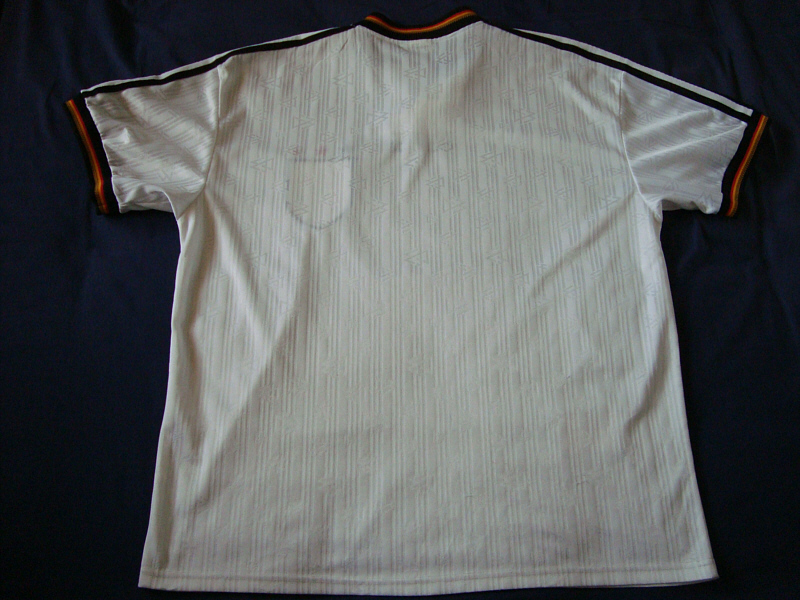
The white home shirt, like the World Cup-winning design of 1990, has become something of a favourite with Germany supporters. It was the first design that saw a change in the appearance of the national eagle and incorporated a retro feel with the buttoned-up collar, but was at the same time fashionably understated. Like the 1994 shirt the white material was “watermarked” with the (now slightly restyled) DFB logo, though rather than a recurring pattern it consisted of the logo in various sizes carefully woven into the design. The “watermark” also included recurring sets of three vertical stripes – the sheer complexity of the design meant that it would have been almost impossible to create a cheap knocked-off version of this shirt.
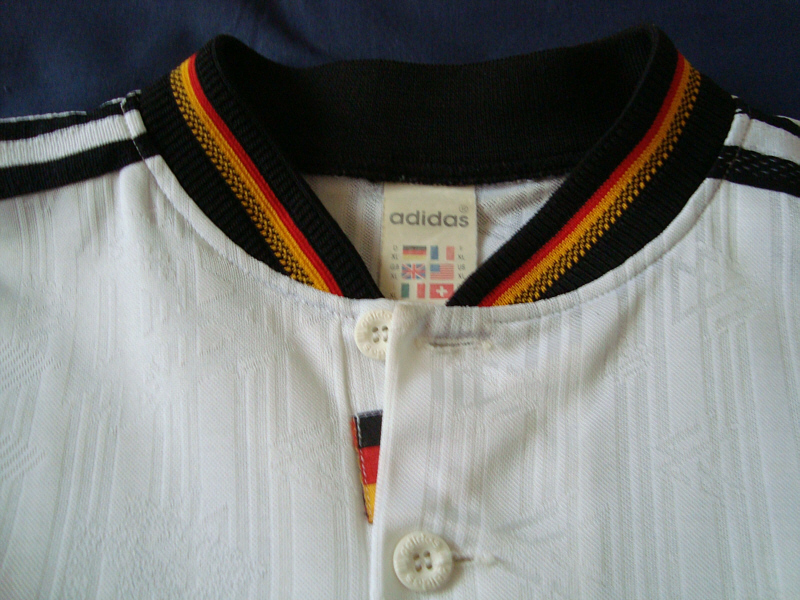
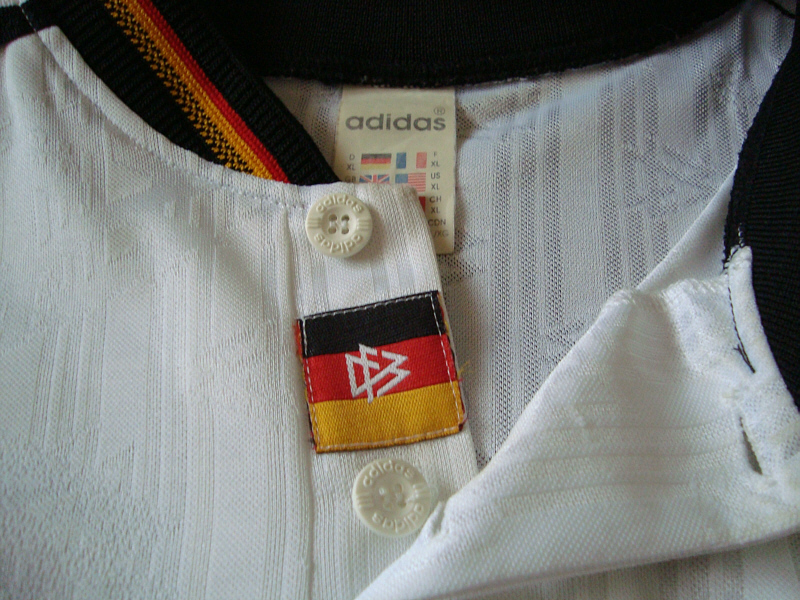
The v-neck of previous designs was replaced in 1996 by a rounder collar with black trim and Schwarz-Rot-Gold piping, and two-rather smart-looking white buttons; between the buttons was a small stylised square flag with a small DFB logo stitched in white thread. The white 1996 design also saw the return of the familiar Adidas three stripes on the shoulder after what had been a four-year hiatus.
It all added up to a design that was clearly made to attract both the terrace traditionalist and the fan-fashionista, and it was clear that replica football shirts had come a long way from the itchy, scratchy and shiny designs of the 1980s. The 1996 white Nationaltrikot was something you could comfortably wear away from the terraces: all you needed to do was just undo one or both of the buttons – or just button them both if you wanted to achieve that winning “Golden Goal” look made famous by Oliver Bierhoff. Or not.
Wearing the wonderfully classic 1996-98 Heimtrikot, Oliver Bierhoff fires the winning goal to win Euro 1996
Probably the most significant visual difference from all white Germany shirts that had gone before was the appearance of the national eagle; rather than the standard black eagle in white roundel on a white background, the new design introduced a shield in black fabric, with the eagle and roundel woven in white/silver thread. Sitting immediately above the shield were the other new additions – three stars, symbolising Germany’s three FIFA World Cup wins in 1954, 1974 and 1990. This innovation soon became a design standard, to the point where all international teams now display a much-coveted star for each major tournament victory. The use of stars on a team logo had for a long time been the standard in Italy – many Italian club sides had incorporated a star to represent championship and cup wins, and the Azzurri had incorporated three stars into their national logo when it was redesigned following their World Cup victory in 1982. The three stars on the German shirt of 1996 were – naturally – Schwarz, Rot, Gold.
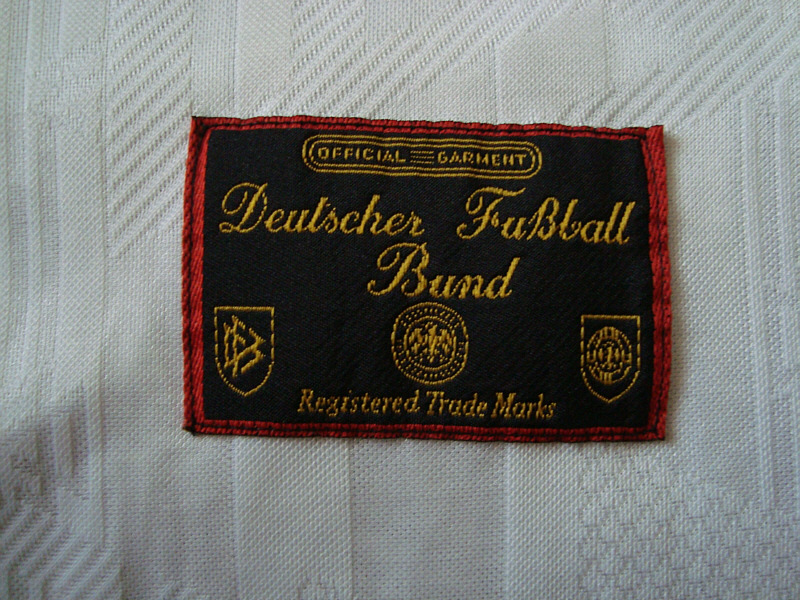
Brand identification was also taken that little bit further with this design – in addition to the DFB logo on the collar flag, the front of the shirt also included a stylised black “official garment” label with “Deutscher Fußball Bund” and the three associated logos in fine gold thread.
The design of the black shorts that accompanied the home shirt would never go back to plain black, but the 1996 look was far more subtle and stylish than the previous effort, with three simple white stripes down the side. The three stripes on the white socks went back to black, but a small national flag device was now added to the design.
The white “shield and stars” shirt is probably one of my favourite shirts in my collection, as I had the pleasure of wearing it at the 1996 final at Wembley when Oliver Bierhoff scored his famous “golden goal” winner against the Czech Republic. As such, I will always associate this shirt with Bierhoff and that wonderful late June afternoon.
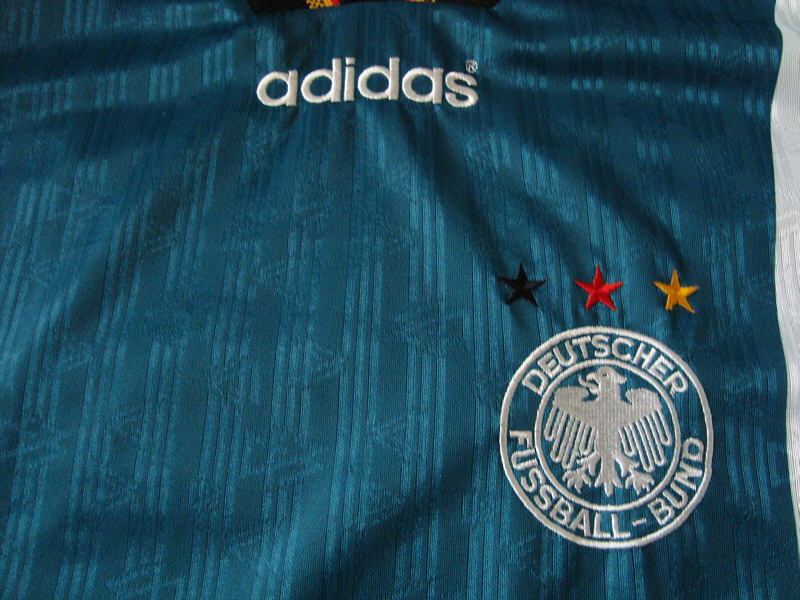
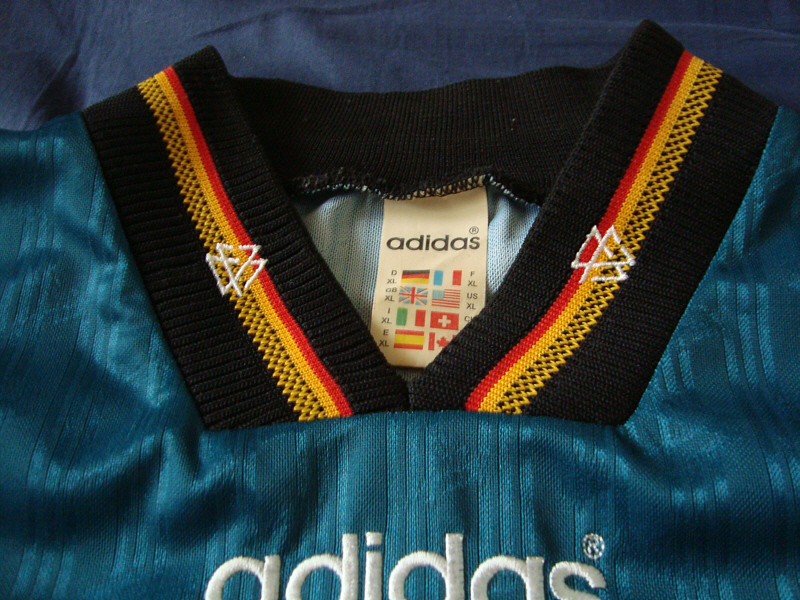
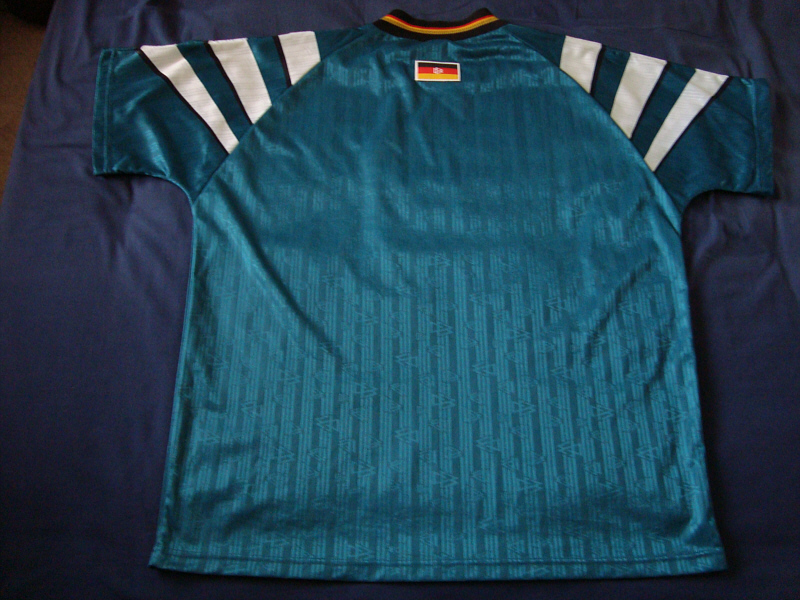
Unlike the previous two designs where the second shirt was of the same essential design as the home one, the 1996 version went for a completely contrasting look. Eschewing the retro collar of the white shirt, this forest green design went for the more conventional black v-neck with gold and red piping and two small DFB logos woven in white/silver thread; the design of the garment itself consisted of three white bands on each side, curving and narrowing down from the shoulder to the waist.
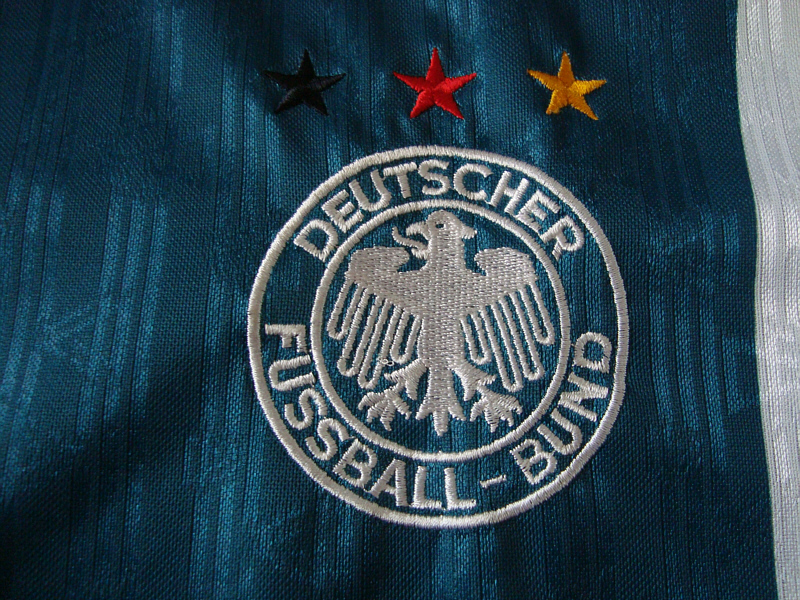
This was a slightly more “generic” design in that it was also used by other international teams, notably Romania; while the white shirt had sported its elaborate “DFB” watermark, this green one had a more conventional recurring three-stripes woven into the material. The (shieldless) national eagle was machine-woven in white/silver thread, and looked much the same as on previous designs. Immediately above the national crest were the three stars, which like on the white shirt were Schwarz, Rot und Gold.
Andreas Neuendorf sports the 1996-98 Auswärtstrikot for the Under-21s against Poland in 1996
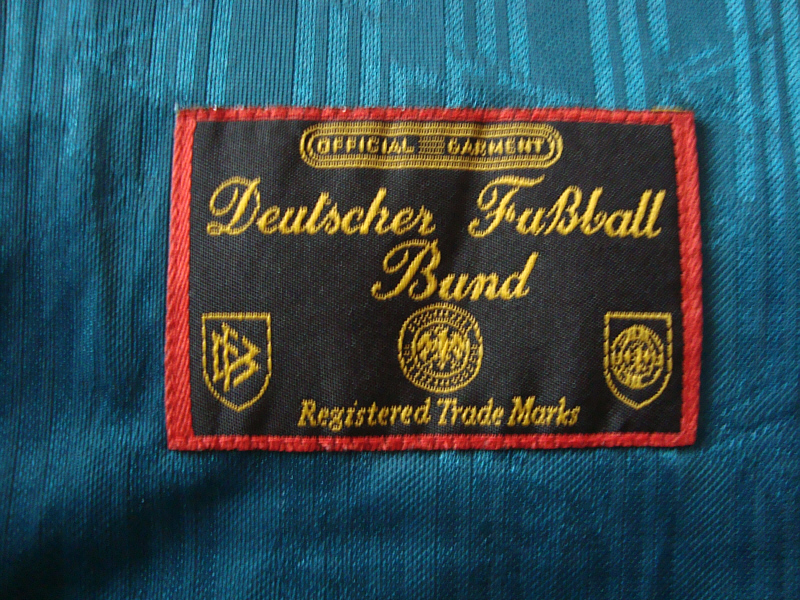
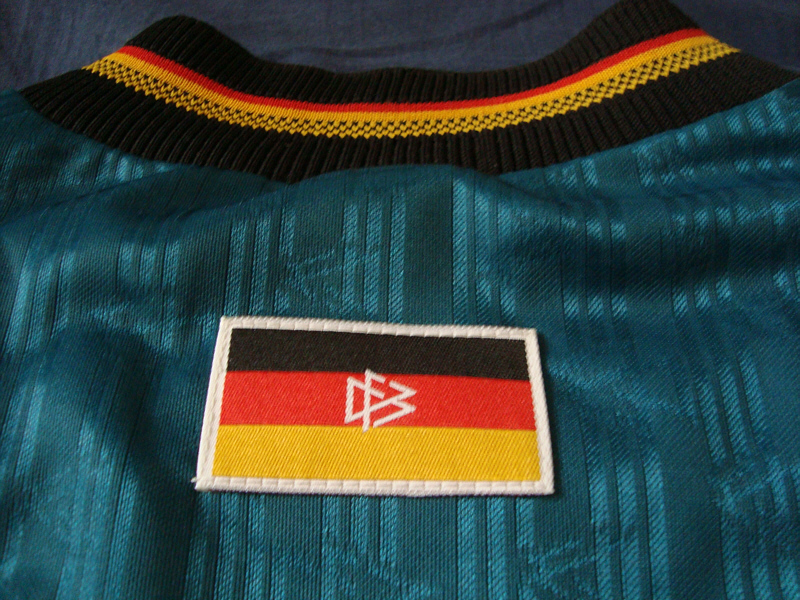
On the back of the shirt near the neckline was a small German national flag with a white DFB device, not dissimilar from the flag found on the inside of the collar of the white shirt; on the front could be found the same “official garment” label.
The green second shirt was worn with white shorts, which featured a single thick green stripe down the side which contained three thinner white stripes; the design also featured the new black shield and white eagle on the right leg. The socks were green with the three trademarked Adidas stripes in white, with the addition of the small national flag.
As far as I can recall this shirt was only used once in actual matchplay – a friendly international against Poland in Zabrze not long after the victory at Wembley in Euro ’96. Although the Nationalmannschaft won 2-0 it was something of a workmanlike performance capped off with a last-minute Klinsmann goal, and as such I can’t associate any particular player with it. In fact, I’d actually associate a particular event where I wore it – the first round Euro ’96 tie at Old Trafford against Russia when I was seated amongst a bunch of friendly and extremely loud Schalke 04 supporters. Though they might have been less friendly had I let on that I was a fan of the Münch’ner.
Tournament Record
1996 UEFA European Championship, England: winners
Shirt Debuts
White: v Denmark, 27.03.1996, München.
Team: Kahn (18. Köpke) – Helmer – Kohler – Reuter (46. Babbel), Freund (85. Albertz), Eilts, Ziege – Häßler, Scholl (76. Basler) – Klinsmann, Bierhoff
Score 2-0 (Bierhoff 44., 61. / -)
Green: v Poland, 04.09.1996, Zabrze.
Team: Kahn – Helmer – Kohler – Reuter (79. Babbel), Strunz, Eilts, Ziege (46. Bode) – Häßler, A. Möller (56. Scholl) – Klinsmann, Bierhoff (76. Bobić)
Score 2-0 (Bierhoff 28., Klinsmann 89. / -)
Shirt Images
Hi Rick, saw that green one in Sainsbury’s in Apsley (near Hemel) today. Had to check out your website to verify the year, it had been bugging me all day! Bit of a random spot.
in Euro 2012 itsis time for germany again!
Hi again, I noticed one mistake, the white 1996-98 shirt debut was actually one match earlier, vs Denmark on 27th March 1996. You can find the footage on Youtube.
The green shirt debut was indeed vs Poland in September 1996, just after the Euro96, though I am not sure if it was a single match in which this very type was used (I will try to check it).
Dzieki Marcin, I have now corrected this. I have written so much I was bound to have made one or two mistakes! I didn’t actually see the Denmark game hence my missing on spotting the then new shirt. I have corrected the error and now put in details and scorers from the Denmark game.