
“I am not responsible for an individual player, but for an entire team.”– Joachim Löw
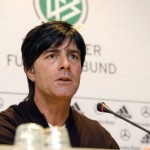
Like Berti Vogts in 1990, Joachim Löw was appointed as Nationaltrainer on the crest of a wave.
Having basked in the Klinsmann-inspired success of the 2006 World Cup there would be none of the intense public and media pressure that had plagued his three immediate predecessors, and the master tactician and strategist long seen as the real driving force behind the new approach in German football would continue to press on in making the changes.
A solid striker
“Jogi” Löw’s professional career as a player would never reach the heights of the likes of a Völler or a Klinsmann, but had been solid enough. Having started off at SC Freiburg in 1977, Löw would experience disappointing spells with both VfB Stuttgart and Eintracht Frankfurt before returning to his first club for two years which saw him score 25 times in 65 outings.
After a season at Karlsruhe SC Löw moved back for his third stint at the Dreisamstadion before moving to Switzerland where he played for FC Schaffhausen, FC Winterthur and FC Frauenfeld. During his three spells in Freiburg the attacking midfielder cum striker would find the back of the net 81 times in 252 games to become the club’s highest goalscorer – a record he still holds.
After what had been a fairly successful if unspectacular playing career spanning some seventeen seasons, Jogi Löw would seamlessly move into coaching by taking up a player-coach role at Frauenfeld.
Astute tactician
Löw returned to Germany in 1995 as assistant to Rolf Fringer at VfB Stuttgart, and would be appointed to the top post with Fringer appointment as coach of the Swiss national team the following year. In what would be a fairly successful two-year spell, Löw led VfB to the DFB-Pokal in 1997 and the final of the European Cup Winners’ Cup the following year, where his side lost a close game to Chelsea.
After moving from Stuttgart Löw was coach at a number of clubs both in Germany and abroad; his first move was to Fenerbahçe in Turkey, followed by a short return to Karlsruhe before heading east again and a disappointing spell at Adanaspor. He then left Turkey for Austria, which saw his winning a second trophy as FC Tirol Innsbruck took the league title. Unfortunately for Löw what had looked set to become a promising coaching career at Innsbruck was cut short as the club was declared bankrupt, forcing him to change jobs again and take the helm at FK Austria Wien – after which came the call from Jürgen Klinsmann asking him to become part of the new-look national team setup.
The power behind the throne. Jogi Löw and Jürgen Klinsmann.
Since turning to coaching at the age of 35, Jogi Löw had quietly and effectively established a reputation as one of the more astute tacticians in the game. This had not been lost on Jürgen Klinsmann, who was quick to get Löw on board as part of a hand-picked management team alongside 1996 golden goal hero Oliver Bierhoff. With Klinsmann’s dynamism and Löw’s tactical nouse, things would click perfectly into place for the Mannschaft in time for the 2006 World Cup finals on home soil; after much navel-gazing by the media, the team would slip into gear and sweep into the last four where they stumbled at the death against an Italian side that would go on to become world champions.
When Klinsmann resigned following the successful third-place playoff match against Portugal, it was an easy decision for the DFB to appoint Löw as his successor; while Klinsmann had been fêted by the media, it had been made clear from the start that his assistant had been the real architect of the team’s new-found success. Like Klinsmann before him, Löw picked an unheralded but well-respected assistant in former Bayern München midfielder Hans-Dieter “Hansi” Flick, with whom he forged a formidable working relationship.
A magnificent start
The new coach’s start in the role was nothing short of magnificent. Picking up where he and Klinsmann had left off in Stuttgart against Portugal, Löw started as he meant to go on with five victories in his first five matches – the best-ever start for any new Nationaltrainer. The team went a record 418 minutes until they conceded their first goal under his tenure, and the first defeat against Denmark came only when Löw fielded a very young and inexperienced experimental side. Germany breezed through their qualifying group for Euro 2008 with plenty to spare, racking up 35 goals in their twelve games which included a record 13-0 destruction of minnows San Marino.
With qualification assured and the future of German football looking bright again, the Mannschaft went into Euro 2008 in neighbouring Austria and Switzerland as one of the fancied teams.
After overcoming a surprise group stage defeat by Croatia, Germany made it into their first Euro knockout game since 1996 with wins over Poland and co-hosts Austria. It was in the game against the Austrians where the otherwise placid Löw had encountered his first brush with controversy: having become involved in a touchline argument with his Austrian opposite number Josef Hickersberger, both men were sent to the stands, with Löw being banned from the dugout for the quarter-final against the Portugal. Unable to communicate with the team, the coach devised a tactical plan which was expertly managed by his assistant Hansi Flick as the Portuguese were defeated 3-2 in a thrilling game.
It was the same result in the semi-final against surprise package Turkey with Löw back in control, as Phillipp Lahm took the Mannschaft to the final in Vienna with a glorious last-minute strike. They were ultimately defeated in the final by Spain – arguably the best team of the tournament – but could hold their heads up high after what had been yet another well-managed campaign.
Always the perfectionist, Löw then sought ways to fine-tune things even further in qualifying for the 2010 FIFA World Cup in South Africa. By picking the team based on form rather than reputation, a pool of competitive and highly motivated players began to develop; instead of seeing the coach turn to a reserve cadre of journeymen as has been the case ten years before, an injury would be seen as an opportunity by younger players champing at the bit to play in the Schwarz und Weiß. While friendly matches were often used to blood youngsters, the full tactical treatment was applied to the more serious competitive fixtures. In what might have been seen as a tough qualifying group that included a Russian side that had impressed at Euro 2008, Löw and Flick engineered a successful and undefeated campaign.
During the qualifying campaign Löw also displayed another side to his personality and management style: he had made his reputation as man who was open and receptive to ideas, but he soon showed that he also didn’t take any nonsense from his players. While he was happy to provide his squad with more latitude in their thinking on and off the pitch, it was also clear that he was a boss who demanded complete respect from his charges. This was best illustrated by the case involving striker Kevin Kurányi, whose petulant stomp-off after being left on the bench against Russia was met with the ultimate sanction. It didn’t matter to Löw if Kurányi was the Bundesliga’s top goalscorer, the sponsors’ favourite or even the King of Siam – he made it patently clear that there was no place for boat-rockers on his squad.
A stunning chapter
The World Cup finals in South Africa would see yet another stunning chapter in the ongoing German football revival, though the buildup was far from encouraging. As the tournament drew near and time was approaching for the squad of twenty-three players to be selected, injury struck. And again. And again. With less than a month to go, the squad were dropping like flies, culminating in the injury to midfield linchpin and skipper Michael Ballack.
In what was probably the biggest gamble in the history of German football, Jogi Löw did not look back to fading stars and journeymen to fill the gaps. Instead, he turned his eye to a raft of younger and less experienced players on the fringe of the squad. Another bold move was the appointment of the captain in the place of the injured Ballack. The diminutive Philipp Lahm may not have been the most imposing personality in the team, but was a smart footballer who had earned the trust of his team mates.
Germany travelled to South Africa with its youngest tournament squad ever, displaying a fearlessness and craft that drew admirers from all parts. In the absence of hitherto indispensable Ballack, Bastian Schweinsteiger was now bossing the midfield, a role in which he revelled. Miro Klose, whose form had been poor in the Bundesliga, had been revitalised by the younger players around him. Lahm, meanwhile, proved to be a natural fit as Spielführer.
Then there were the players who were playing their first major tournament: playmaker Mesut Özil, who brought both pace and guile to the midfield; Sami Khedira, who would contribute a mix of intelligence and strength; and then the find of the tournament, Bayern München’s twenty year old winger Thomas Müller, who had started the season on the bench for his club side and ended it by winning both the golden boot and the best young player award.
The team not only almost achieved the impossible, but more crucially displayed a level of spirit and commitment worthy of the great German teams of old; their being able to blend this with a new-found creativity would make Löw’s young side the most watchable team in the tournament. When the opening 4-0 demolition of Australia was followed by an unlucky 1-0 defeat to Serbia, the team bounced back with a disciplined display against Ghana to secure their place in the knockout stage. Here they would truly come into their own, destroying England 4-1 in the second phase and then steamrollering the much-fêted Argentinians 4-0 in a memorable quarter-final.
It was scarcely believable, but just as in 2006 the end came in the semi-finals – where an impressive Spain side embarked on a successful campaign of strangulation and suffocation.
With sixteen goals from seven games and a second third-place finish in successive tournaments, the face of German football had undergone the second phase of its transformation. The process that had been started by Jürgen Klinsmann had been followed through with both enthusiasm and determination by Jogi Löw – the man in the blue cashmere sweater.
The man in the blue cashmere sweater. Jogi Löw directs operations at the 2010 World Cup in South Africa.
Following the success in South Africa the team went from strength to strength as Löw continued adding to a pool of highly talented young players. The qualifying campaign for the 2012 European Championships in Poland and the Ukraine would be a complete success, as the Mannschaft achieved a record ten wins from ten games – racking up 34 goals in the process. This was the first time the team had returned a perfect record in a major tournament qualifying group for 30 years, when Jupp Derwall’s side would win eight games out of eight in qualifying for the World Cup in 1982.
Tactical failure
The Euro 2012 campaign saw the Mannschaft start out as one of the tournament favourites, enhancing their reputation with three wins from three in the group phase – the first time any German side had achieved the feat. After an encouraging and emphatic 4-2 quarter-final against Greece, Löw’s side had putting together a phenomenal run of fifteen competitive victories in a row – a record stretching back two years to their 3-2 win over Uruguay in the third place playoff at the World Cup.
Up against old rivals Italy, the Mannschaft were big favourites. The long winning run they brought into the semi-final was in stark contrast to the scratchy form show shown by the Azzurri, and it finally seemed as though the Germans would break the spell that had been weaved by the Italians in competitive meetings over the years.
It was not to be. Löw had worked to a clear plan for the first four matches, but changed his approach completely for the semi-final. Rather than play to his teams many strengths, a greater emphasis was placed on the opposition. The plan backfired completely, as a disjointed, disoriented and disappointingly inept German team found themselves two goals behind at half time.
The second half was marginally more competitive, but the damage had been done. Löw’s change of tactics had been a failure, and more than anything else appeared to expose a lack of confidence in his young side as well as his own frailties.
His head in his hands, the disappointed Nationaltrainer with Hansi Flick and Andy Köpke during the Euro 2012 semi-final
When examined in a wider context, the Euro 2012 campaign was hardly a disaster. A disaster, for those who could remember it well, was Euro 2000. It was, however, the lowest point of the Löw era. The bar had been raised considerably since 2006, to the point where a semi-final exit could be considered a failure. For many however, it was not the semi-final elimination itself that was the problem, but the nature of the defeat. Germany were a far better team than Italy, and yet it was the Italians who were in the final. For many critics, the match had been handed over on a plate.
Although Jogi Löw would continue to do things his way, the disaster in Warsaw would teach him a valuable lesson. It was a lesson that he would heed in the World Cup in Brazil two years later.
Flirting with disaster
Jogi Löw’s eight-year record as Nationaltrainer had been impressive, but for many years it had been a case of so near, yet so far. The so-called golden generation had failed to deliver, and time was running out. For many of the squad who were assembled for the 2014 World Cup, it would be the last hurrah. For the coach, it was an opportunity to correct the failure of Euro 2012.
Things would not start well. Pre-tournament form was patchy at best, as Löw looked at implementing a more Spanish-style 4-3-3 with captain Philipp Lahm at the centre of the defensive midfield. Armenia were comfortably dispatched 6-1 in the final warmup match, but there was a distinct lack of confidence in some sections of the German media. Then there was the withdrawal of key man Marco Reus, just one more name in what was a growing injury list.
Despite all of these problems, the 23-man squad arrived at the team’s base camp in Brazil in good spirits. Much of this was down to the coach, whose disciplined yet tactile approach had engendered a feeling of genuine community and camaraderie.
On the pitch, it was a mixed bag. An emphatic demolition of danger team Portugal kick-started the campaign in fine style, but this was followed by a messy 2-2 draw with Ghana. A solid but hardly inspiring 1-0 win over the United States was enough to secure passage into the knockout phase, but for many observers it was less of a march than a stagger. No knives were being sharpened – yet – but the whetstones remained on the workbench.
Second round opponents Algeria were not expected to provide much of a test, but the reality was completely different as the Germans flirted with disaster. Against an energetic and determined opponent, the defence was a complete shambles. One of the biggest features of the match were the last-ditch clearances made by goalkeeper Manuel Neuer, and the lack of a quality right back allowed the Algerians to create far too many opportunities.
In the end, the North Africans’ profligacy in front of goal would be their undoing. Les Fennecs had done enough to take the match into extra time, but goals from André Schürrle and Mesut Özil would prove to be enough for Löw’s men. Even then, there were more than a few last-moment nerves as Algeria pulled a goal back before throwing everything forward in search of an unlikely equaliser.
The turnaround
Following the narrow win over Algeria, Löw found himself standing at a crossroads. He had made it clear that he would stick with his decision to play 4-3-3 with Philipp Lahm in midfield “to the end”, and his continuing to hold onto this position was the subject of much heated discussion in the German media.
With Germany facing a far more potent and in-form France team in the last eight, the intransigent and bloody-minded coach looked to be heading out onto the deck with his sword firmly in hand and ready to fall on it should things not go his way. For some, it was like Italy in 2012 all over again.
At this point, things turned around completely. When the team was announced ahead of the quarter-final, there was a far more familiar 4-2-3-1 with Lahm back at right back and both Sami Khedira and Bastian Schweinsteiger in the defensive midfield. Had the coach buckled and given in to media pressure? Judging by his actions over the previous eight years, this was clearly unlikely.
As it turned out, the decision was the result of much thinking and discussion in the German camp. Löw was always going to end up in a Catch-22 situation: defeat would see him either having to defend his intransigence on one hand, or a weakness in the face of media criticism on the other. But Joachim Löw had always been his own man, and this time he would make the right decision.
The 4-3-2-1 would hold firm against the dangerous French, with an old-fashioned set-piece goal from centre-back Mats Hummels settling the issue early on. Despite one big scare right at the death, it had been a solid display.
Vindication in Rio
Jogi Löw had guided Germany to a record-setting fourth successive World Cup semi-final, but the best was yet to come. In a match that will probably be seen as the defining moment of his time in charge, hosts Brazil were subjected to a morale-shredding defeat that at times beggared belief.
On what was a balmy (and barmy) evening in the southern Brazilian city of Belo Horizonte, the hosts – unbeaten on home turf in almost four decades – would fall victim to the a free-flowing, confident Mannschaft that oozed the coach’s philosophy of stylish yet clinical football.
When the first goal went in, it was all about settling the nerves. By half time, the Germans had hit five goals without reply. Three of these would come in the blink of an eye as the men in yellow were torn apart like cheap paper. Two more goals were added in a less frenetic second half, with the annoyance of a Brazilian consolation right at the end.
After the massacre. Löw commiserates with his Brazilian counterpart Luiz Felipe Scolari after the semi-final in Belo Horizonte
7-1. A magical scoreline on what was arguably the great result in the history of Germany’s long and rich footballing history. The architect: Jogi Löw.
If the brutally beautiful slicing and dicing of Brazil had been a game for the ages, a more hard-fought final against a gritty Argentina at the Maracanã would finally deliver the trophy all of Germany had yearned for. It had been a hard-fought contest that had looked set to go the distance, but substitute Mario Götze’s magical strike seven minutes from the end of extra time would seal the title for Jogi’s Jungs.
Götze had been far from his best during the tournament, but had justified the coach’s faith in him when it mattered. After the match, Löw would say that he had urged the young player to show the world that he was better than Argentina’s talismanic captain Lionel Messi. Mere words, yes, but words that would become part of the developing legend.
Danke, Jogi! Löw gets his hands on the precious golden World Cup trophy, and is applauded by his victorious team
The DFB’s faith in Jogi Löw and the decision to extend his contract to 2016 before the tournament had been vindicated. The quiet man from Freiburg had joined Sepp Herberger, Helmut Schön and Franz Beckenbauer as a World Cup winning coach.
Falling short in France
Following a sketchy qualifying campaign that was largely blamed on the hangover following the World Cup – as well as a number of significant player retirements including skipper Philipp Lahm – Germany made it to the finals in France. In the months approaching the tournament, things were not great. As well as injuries to key players, the poor form continued; the team had found it difficult to square goals, and following some patchy warmup performances the optimism the followed the triumph in Rio had largely been tempered.
Germany, however, were the ultimate tournament team. A 2-0 win over Ukraine in their opening game got things off to a winning start, but a lucky goalless draw against Poland forced the coach to do away with his “false nine” tactic and restore striker Mario Gómez to the starting lineup. The move worked, and a 1-0 win over Northern Ireland – a game that would have seen many more goals were it not for the opposition goalkeeper – was followed by a far more convincing 3-0 win over Slovakia.
The quarter-final pitted Germany again old rivals Italy, and finally the long years of hurt were cast aside. At the ninth attempt, the Azzurri were finally beaten in a major competitive international; it took a crazy and nerve-shredding penalty shootout to achieve the feat – in which Thomas Müller became the first German player to miss in a shootout since 1982 – but the Mannschaft were once again in the last four.
It was Germany’s fifth straight semi-final under Löw – a staggering achievement when one considers that England have only reached four major tournament semi-finals in their entire history – going through seventeen managers in the process.
Next up were hosts France in Marseille, a task that proved just too much of a hurdle for a German side that suddenly had to deal with a spate of injuries and the suspension of Mats Hummels – scorer of the winner against Les Bleus in Brazil two years earlier. Germany dominated the game for long spells and looked as though they would overwhelm the French, but in the end a distinct lack of firepower up front proved to be their undoing. An unfortunate penalty for the home side turned the game completely on its head on the brink of half-time, and a second with just under twenty minutes remaining proved decisive.
Germany continued to fight, but it was one of those nights where everything conspired against them. Unlike in 2012 the coach had done little wrong, but was still left cutting a forlorn and frustrated figure on the touchline. The “Maharishi Jogi” would certainly have his fair share of detractors, but he could rightly be proud of himself and his team.
The talent factory
Things had not gone to plan at Euro 2016, with injuries and bad luck ultimately derailing what had been a well-drilled campaign. Germany had arguably been the best team of the tournament, and there were plenty of solid foundations to build on. As the 2016/17 season would prove, these foundations were a lot stronger than anybody had thought. The first mission for the coach was to guide the team through the first year of World Cup qualifiers, and this was duly achieved with six wins from six. After that would come the summer break, and the FIFA Confederations Cup.
Germany had always seen the Confederations Cup as something of a training exercise, and it was no different in 2017. Jogi Löw would choose to rest all of the big names for the eight-team summer tournament in Russia, putting together a squad that featured a mix of fringe players, solid Bundesliga performers and a clutch of up-and-coming youngsters. The decision was made to split the youth contingent with the squad competing at the Under-21 European Championship, a move that many saw as spreading the available talent far too thinly.
Not many had given the weakened Under-21 squad much hope of taking the title in Poland, while the objective for the experimental “senior” side in Russia was the last four. In the end, the results would make the watching world sit up and marvel at the depth of talent wearing the famous white Trikots.
While Stefan Kuntz’s Under-21s would go on to overcome red hot favourites Spain to claim the junior crown for the first time since 2009, Jogi Löw’s squad would also surpass themselves in Russia. The young players were quick to climb the steep learning curve, and despite a few wobbles the team would come through against opponents that were far more experienced.
An opening group containing Australia, Chile and Cameroon was carefully and confidently negotiated. There were a few wobbles and shakes, but that was the whole idea. The coach played with different combinations, giving all but two of his 22-man squad a start as he applied a gentle rotation. The well-balanced mix of young players and handful of experienced old heads had started to enjoy the experience, and a thrilling 4-1 victory in the semi-final against a seasoned Mexico side would provide ample evidence of the team’s development in the rarefied air of tournament competition.
“I am getting used to this”. Jogi Löw takes hold of another golden global trophy in St. Petersburg
By the time Löw’s side took on the highly experienced Chileans in what was a repeat of their tight group phase encounter, everything had fallen into place and was starting to click. It was a hard-fought win against skillful and fiercely determined opponents, but the players had vindicated the coach’s decisions. The team was still a work in progress, but the campaign in Russia had been an unqualified success. A second international trophy was in the bag.
Record-breaker
Whichever way you look at the numbers and in spite of the failure in Russia, Jogi Löw’s records are mightily impressive. Following the victory in the Confederations Cup Final, he had won 102 of his 152 matches in charge – or 103 if you include the penalty shootout victory over Italy at Euro 2016.
Löw’s winning percentage also puts him top of the pile. While Sepp Herberger had taken 167 matches to reach the figure of 94 victories, Löw would take just 141 (or 140, again, dependent on the penalty shootout as a win issue). In terms of winning percentages, the current Nationaltrainer has put together a 67.8% winning record, 0.6% ahead of Jupp Derwall, who was in charge for less than half the number of matches between 1978 and 1984.
In competitive internationals, Löw’s record currently stands at seventy-five victories, ten draws and just nine defeats – a winning rate of just under eighty percent, far and away ahead of his predecessors.
Löw’s 152 matches in charge puts him just fifteen behind Sepp Herberger’s all-time record of 167, a deficit that will be reduced to just eight by the end of the 2017/18 season with all of the upcoming fixtures planned to date. Given that there will be at least two warm-up matches before the World Cup finals, it is possible that Herberger’s record could be overhauled during the tournament in Russia itself. Löw is also six matches away from coaching a century of competitive internationals, a landmark that will be reached during the group stages of the World Cup. The path could not have been plotted any better.
The slide
The story of 2018, to be added.
International Career Record as Player
n/a
Tournament Record as Player
n/a
Career Record as Coach
First match as coach: 16.08.2006 3-0 (3-0) v Sweden, Gelsenkirchen (B. Schneider 4., Klose 8., 44. / –)
Final match as coach: 29.06.2021 0-2 (0-0) v England, Wembley (– / Sterling 75., Kane 86.)
Total matches: 198
Wins: 125* (63.1%)
Draws: 39 (19.7%)
Defeats: 34 (17.2%)
Goals For (goals scored per game): 467 (2.36)
Goals Against (goals conceded per game): 200 (1.01)
Competitive matches: 126
Wins: 92* (73.0%)
Draws: 16 (12.7%)
Defeats: 18 (14.3%)
Goals For (goals scored per game): 327 (2.60)
Goals Against (goals conceded per game): 112 (0.89)
Friendly matches: 72
Wins: 33 (45.8%)
Draws: 23 (32.0%)
Defeats: 16 (22.2%)
Goals For (goals scored per game): 140 (1.94)
Goals Against (goals conceded per game): 88 (1.22)
Results Breakdown by Year
*matches listed as wins include the penalty shootout victory against Italy (UEFA European Championship Semi-Final, 2016)
Tournament Record as Coach
UEFA European Championships Austria/Switzerland 2008 – Runners-up
FIFA World Cup South Africa 2010 – Third Place
UEFA European Championships Poland/Ukraine 2012 – Semi-finalists
FIFA World Cup Brazil 2014 – Champions
UEFA European Championships France 2016 – Semi-finalists
FIFA Confederations Cup Russia 2017 – Champions
FIFA World Cup Russia 2018 – Group Phase
UEFA Nations League 2019 – League Phase
UEFA European Championships 2020* – 2nd Phase
UEFA Nations League 2021 – League Phase
FIFA World Cup Qatar 2022 – Resigned during Qualifying Round
* Tournament postponed until 2021